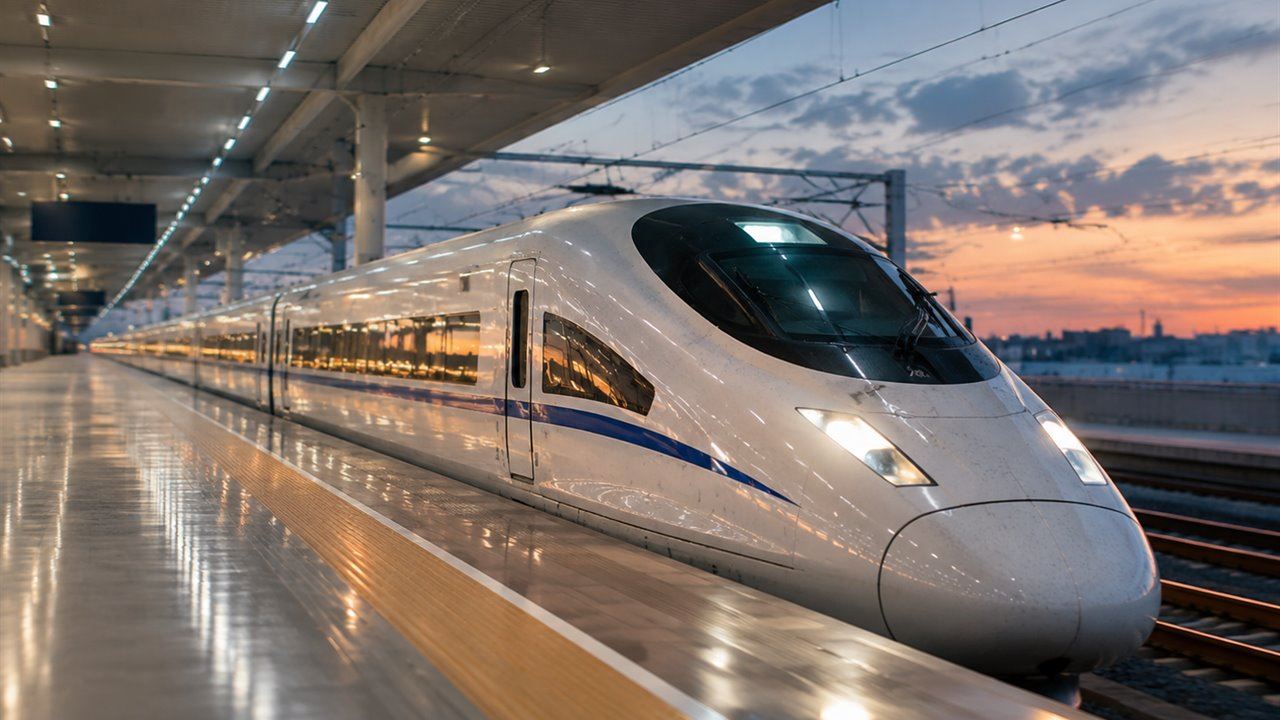
China’s high-speed rail is the reason most visitors stop flying between big cities. A high-speed train covers Beijing to Shanghai in about 4 hours 30 minutes, city centre to city centre, and you board with the passport you booked with rather than a printed ticket. Book on 12306, the railway’s official English site, or at a station window with your passport in hand.
- Passport, not paper — your passport is the ticket; there is nothing to collect at the station.
- Book ahead — popular routes and holiday dates sell out days or weeks in advance.
- Arrive 45–60 minutes early at a big station, and more at a holiday peak.
- Register first — 12306 needs your passport number and name, verified before you can buy.
- Some gates can’t read a foreign passport — use the staffed lane and keep the passport out.
Last verified: 29 October 2026 · Sources: Hunan provincial government English portal, 12306 (China Railway official booking site), Travel China (Ministry of Culture and Tourism)
Should you take the train or fly between Chinese cities?
Take the train for anything under about five hours of rail time, and fly only when the rail journey crosses most of the country. The reason is not comfort, although the trains are comfortable. It is that rail time is door to door while flight time is not: airports sit outside the city, check-in and security take an hour, and a two-hour flight routinely consumes five hours of a day.
Run the comparison honestly. Beijing to Shanghai is about 4 hours 30 minutes by high-speed train and about 2 hours 15 minutes in the air, yet the train wins because both stations are in the middle of the city and you can arrive 45 minutes before departure rather than 90. Beijing to Xi’an, Xi’an to Shanghai and Shanghai to Hangzhou all fall the same way. Only routes like Beijing to Guangzhou, where the train takes eight hours or more, make the flight genuinely better.
| Route | High-speed rail, approx. | What the train gives you |
|---|---|---|
| Beijing to Shanghai | about 4 hours 30 minutes | City-centre to city-centre; the single best rail route in the country |
| Beijing to Xi’an | about 4 hours 30 minutes to 6 hours | Depends on the service; the fastest trains are worth paying for |
| Xi’an to Shanghai | about 6 hours | A long but productive day; book a morning departure |
| Shanghai to Hangzhou | about 1 hour | Easier than commuting in most cities; do it as a day trip |
| Guilin to Guangzhou | about 2 hours 30 minutes | Connects the karst country to the southern hub without a flight |
How do you book a train with a foreign passport?
Register on 12306 with your passport number, your name exactly as printed and your nationality, then buy online, or walk up to a station window and pay there. Registration normally verifies automatically against the immigration record. When it does not, the site asks you to upload a photo of your passport data page for manual verification, which can take a day or two, so start the account before you need it.
- Create the account on the English site or app. Use the passport you will travel on. A different document at the gate than at booking is a problem you cannot fix at the station.
- Enter the name exactly as printed in the machine-readable zone, with the same order and spacing. Middle names are the usual source of failed verification.
- Wait for verification. If it does not clear within an hour, upload a photo of the passport data page and try the purchase again the next day.
- Search by city pair and date, then compare departure times rather than prices alone; a train 40 minutes later can be an hour faster.
- Pay and save the confirmation. Screenshot the order number and the carriage and seat numbers. You will not get a paper ticket.
- Alternative channels are the station window with your passport and cash or card, and third-party agents such as Trip.com, which typically add a booking fee for the convenience.
Hunan province’s English government service guide tells foreign passengers that rail tickets are bought against the passport, that the same original document must be used to enter and exit the station, and that travellers should arrive well before departure rather than cutting it fine, because passport checks at the gate take longer than a national ID scan. Close paraphrase of the Hunan provincial government transport guide, 29 May 2025.
What are the seat classes, and which should you book?
Three classes sit on most high-speed trains, and the differences are space, not service. Second class is five seats across in a 3+2 layout and is what most Chinese travellers buy. First class is four across in a 2+2 layout with wider seats. Business class is a pod-style cabin with three seats across and a lie-flat seat on some trains; published fares typically put it at around three times second class, which is editorial judgement rather than a rule.
| Class | Layout | Who it suits | Notes |
|---|---|---|---|
| Second class | 3+2, five across | Most travellers, most trips | Reasonable legroom, overhead luggage, power at the seat on newer trains |
| First class | 2+2, four across | Longer legs and working journeys | Wider seat, more recline, quieter carriage; often about 60% more than second |
| Business class | 2+1 pods, three across | Special occasions, overnight-adjacent legs | Lie-flat on some sets, lounge access at some stations, and the most expensive class by a wide margin |
| Sleeper (overnight D, Z, T, K) | Soft or hard berths | Overnight legs where the train saves a hotel night | Different booking flow; hard sleeper is six berths in an open bay |
Book second class unless the leg is over four hours or you need to work. The upgrade to first class buys space and quiet rather than service, and on a two-hour hop it is hard to justify. If you are travelling with luggage you cannot lift, first class has more room to manoeuvre at the ends of the carriage, which matters more than the seat itself.
Do you still need a paper ticket?
No. Since the e-ticket rollout, the passport you booked with is the ticket: you tap or present it at the gate and the system finds the booking. If you want a paper receipt for expenses, ask at a ticket window or a self-service machine with the passport, and you will be issued one, but you do not need it to travel and staff will not ask for it.
The practical consequence is that losing the passport is now losing the ticket as well. A photo of the data page is not a substitute at the gate; it can help at a police station, not at a turnstile. Keep the passport in the same pocket every day of the trip, and if you are travelling with someone else, do not put both passports in one bag.
How early do you need to be at the station?
Arrive 45 to 60 minutes before departure at a major station such as Beijing South, Shanghai Hongqiao or Xi’an North, and 90 minutes at a holiday peak. The stations are large, security is at the entrance rather than at the platform, and the walk from the entrance to the correct waiting area can take ten minutes on its own. Late arrivals are not accommodated.
- Security first. Bags go through a scanner at the station entrance. Liquids are not the issue that they are at airports, but power banks and lighters get looked at.
- Then find the waiting area. Your carriage number determines which waiting zone and which gate. The departure boards show the train number, not the destination city alone.
- Gates close before departure. The gate for a high-speed service typically closes a few minutes ahead of the scheduled time, and the platform is a long walk from the concourse.
- Use the staffed lane if the gate will not read your passport. Automatic gates are built around national ID cards and some cannot read a foreign passport at all. Staff will wave you through the adjacent lane.
Which routes replace flights?
The corridor that matters most is Beijing to Shanghai, with Xi’an as the hinge between them, and Hangzhou hanging off Shanghai to the south. Guilin to Guangzhou joins the karst country to the southern hub. Everything below is rail time, and every figure should be re-checked on 12306 when you book, because timetables change with each season’s adjustment.
| Leg | Approx. time | How it fits an itinerary |
|---|---|---|
| Beijing to Xi’an | 4 hours 30 minutes to 6 hours | Morning departure, afternoon at the city wall |
| Xi’an to Shanghai | about 6 hours | A travel day; leave after breakfast |
| Shanghai to Hangzhou | about 1 hour | A day trip, or a base for West Lake |
| Guilin to Guangzhou | about 2 hours 30 minutes | The exit leg to a southern flight home |
Read the corridor as a line rather than a star. Beijing, Xi’an, Shanghai and Hangzhou sit on one continuous rail spine, so a trip that moves along it never doubles back. That is the shape the 7-day itinerary uses, and it is why the order of cities matters more than the number of them. Start with the Beijing guide, add Xi’an, and finish in Shanghai.
What about luggage, food, refunds and changes?
Luggage rules are generous by airline standards and loosely enforced. There is no weighing at the gate, overhead racks take a cabin bag, and larger cases go on the rack at the end of the carriage. Food is sold from a trolley and a dining car on longer services, and bringing your own is normal and expected. Refunds and changes are where the rules bite: the fee depends on how far ahead you cancel and is shown before you confirm.
- Luggage. Two bags per person is the practical limit, and a large case at the end of the carriage is normal. Do not leave valuables in it.
- Food. Instant noodles are a national train food for a reason: hot water is free at the end of each carriage. Station shops sell snacks at city prices.
- Changes. You can usually change to another train on the same day at the station window, subject to availability and a fee. Do it before departure, not after.
- Refunds. The closer to departure, the higher the deduction. The exact fee is displayed when you cancel, and it is deducted from the refund rather than charged separately.
- Missed trains. A missed high-speed train is generally treated as a change rather than a loss, but only if you go to the window promptly and there is space later that day.
The map question, answered in words
Visitors ask for a rail map and what they need is a line. Draw it as Beijing in the north, Xi’an about four and a half hours southwest, Shanghai six hours southeast of Xi’an, Hangzhou an hour south of Shanghai. Add Guilin and Guangzhou as a separate southern pair, connected to each other in about two and a half hours but not to the northern spine without a flight or a long day on the train.
That shape answers most itinerary questions by itself. A week fits Beijing, Xi’an and Shanghai if you move every third day. Ten days adds Hangzhou or a Yangtze detour. Anything with Guilin in it needs a flight unless you are crossing the south anyway, which is why the southern route is usually bolted on at the end rather than woven through the middle.
Some links on this page are affiliate links. If you buy through them we may earn a commission at no extra cost to you. We do not accept payment for rankings.
FAQ
Can I buy a train ticket at the station with a foreign passport?
Yes. Station ticket windows sell to foreign passports, and you pay with cash or a card. Bring the passport itself. The window is the fallback when online booking fails, and it is often quicker at small stations than at Beijing South or Shanghai Hongqiao on a holiday.
Do I need to print my ticket?
No. The passport is the ticket. You present it at the gate and the booking is found from it. A paper receipt can be issued at a window or machine if you need one for expenses, but it is not required to board and no one will ask for it.
What happens if my 12306 verification fails?
Upload a clear photo of your passport data page when the site offers the manual route, then allow a day or two. Check the name order and spacing against the machine-readable zone. If it still fails, buy at a station window or through an agent such as Trip.com.
Is second class comfortable for a five-hour journey?
Yes, for most people. It is five seats across with reasonable legroom, power at the seat on newer trains and a fold-down table. If you plan to work, or the leg is over five hours, first class buys noticeably more space and a quieter carriage.
Can I take luggage on a high-speed train?
Yes, and there is no weighing at the gate. A cabin bag goes overhead and a large case goes on the rack at the end of the carriage. Two bags per person is the practical limit, and valuables should stay with you rather than in the rack.
Sources
- Hunan provincial government — rail travel and passport rules for foreign passengers (29 May 2025)
- 12306 — China Railway’s official English booking site
- Travel China (Ministry of Culture and Tourism) — high-speed rail in China
- National Immigration Administration — accommodation registration notice (20 March 2026)
Trains are the backbone of a multi-city trip. Read the practical China hub for what to arrange before you land, and sort out money for the ticket window with the payments guide.
Disclosure: this page may contain affiliate links. If you book through them, we may earn a commission at no extra cost to you, and it never changes what we recommend. See our affiliate disclosure.