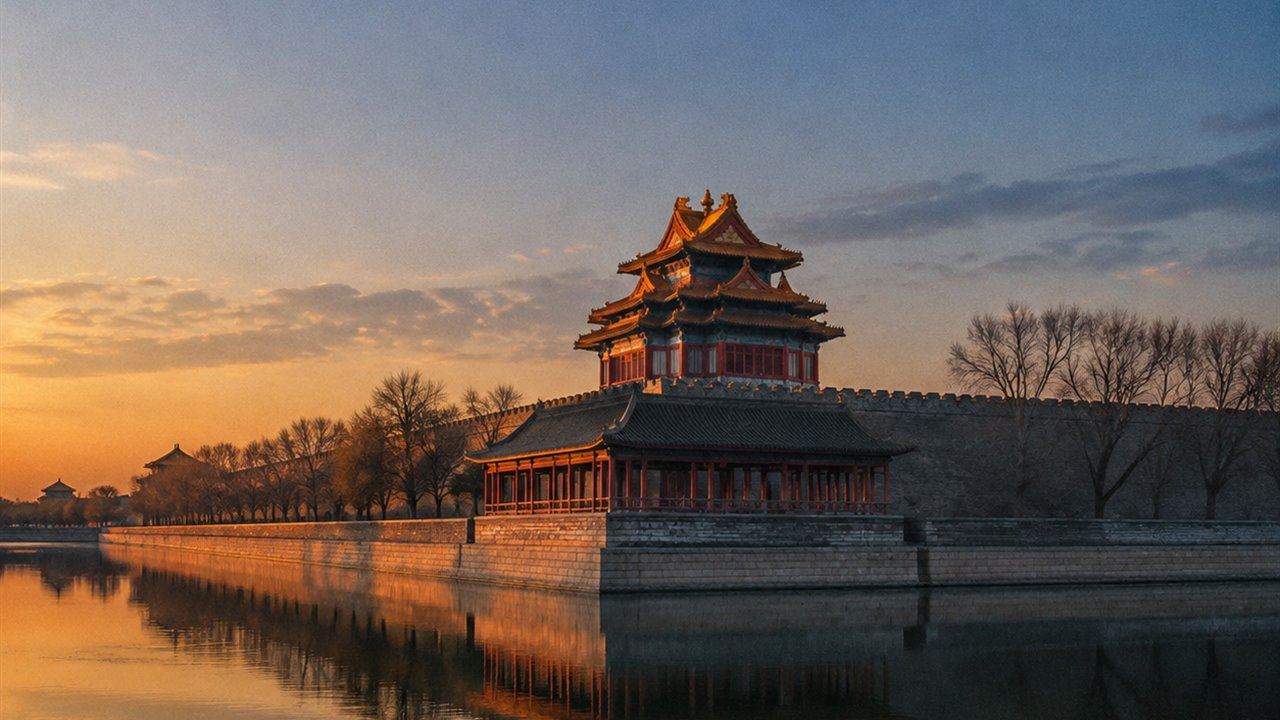
Seven days on the ground means three nights in Beijing, two in Xi’an and two in Shanghai, linked by G-trains of about four and a half to six hours. You cover the Forbidden City, a Great Wall section, the Terracotta Warriors and the Bund without a single internal flight, and every ticket and train seat in the plan can be booked from outside China.
- 7 nights Beijing 3 · Xi’an 2 · Shanghai 2
- 2 train legs Beijing-Xi’an, Xi’an-Shanghai
- 7 days ahead Forbidden City tickets open at 20:00 Beijing time
- CNY 60 Forbidden City peak-season ticket, 1 April to 31 October 2026
- CNY 25 Beijing Capital Airport Express, one way in 2026
Last verified: 29 October 2026 · Sources: National Immigration Administration (NIA), Forbidden City ticketing, China Railway 12306
What does seven days in China actually cover?
Seven days on the ground covers the three cities a first trip needs and nothing else: three nights in Beijing for the Forbidden City and one Great Wall section, two nights in Xi’an for the Terracotta Warriors and the city wall, two nights in Shanghai for the Bund and the French Concession. That is four full sightseeing days, two travel days and one arrival day.
The order matters more than the stops. Beijing first puts the jet lag behind you in the city with the most early starts. Xi’an sits between Beijing and Shanghai on the high-speed corridor, so both long legs run in the same direction and neither doubles back. The itineraries hub compares this route with the 10-day versions, and each city has a deeper guide: Beijing, Xi’an and Shanghai.
Before you book anything, confirm which entry rule applies to your passport. Holders of the 50 visa-free passports can enter for up to 30 days; US, Indian, Indonesian, Mexican and Philippine passports are not on that list and need either the 240-hour transit rule or a visa. The visa overview compares the three routes and the visa checker settles it in one screen.
Who this route suits: a first trip, a couple or a parent travelling with one teenager, and anyone who would rather take two trains than three flights. It suits you less if you want countryside, if you are travelling with children under five, or if you have already seen Beijing – the hub page explains which alternative fits each of those cases.
What must you book before you leave home?
Four bookings decide whether this itinerary survives contact with China: Forbidden City tickets, a Great Wall section, Terracotta Warriors tickets and the two G-trains. Three of them are real-name, which means your passport number, and the Forbidden City releases seats seven days ahead at 20:00 Beijing time. In peak season, missing that release costs you the day.
- Forbidden City: real-name booking with your passport, one ticket per ID per visiting day, released at 20:00 seven days before the visit date. CNY 60 in peak season (1 April to 31 October 2026) and CNY 40 off-peak; the Treasure Gallery and Clock Gallery are CNY 10 each. Closed Mondays except statutory holidays.
- Terracotta Warriors: passport-based real-name booking through the official channel; in peak season book as soon as your date is fixed and carry the passport you booked with.
- Great Wall: Badaling requires a real-name reservation and enforces a daily visitor cap, so book on the official channel rather than turning up; quieter sections need a longer transfer, not a ticket.
- G-trains: China Railway releases seats on a rolling sales window that changes, so check 12306 for the current opening date and buy the moment it opens for 1-7 October or Chinese New Year dates. Register your passport on 12306 before you fly, because verification can take a day if the automatic check fails and you upload a photo.
- Hotels: a Beijing hotel near a Line 1 or Line 2 station saves more time than any other upgrade, and the hotel files your accommodation registration for you.
“Visitors must book by real name; one ticket per ID for each visiting day; tickets go on sale at 20:00 seven days before the visit date.” – Forbidden City ticketing notice at ticket.dpm.org.cn, translated from Chinese, checked 29 October 2026.
20:00 in Beijing is 12:00 UTC – which is 08:00 in New York during daylight saving and 07:00 in winter. Put the alarm in your home time zone, not Beijing time, or you will be refreshing the page on the wrong evening.
The seven days at a glance
The table is the copyable plan; each day is explained underneath with its booking deadline and its failure mode. Cost bands are editorial estimates for one person per day in 2026, excluding international flights and the two intercity train tickets: Budget CNY 350-600, Mid CNY 700-1,100, Comfort CNY 1,500 and up, assuming a double room shared by two.
| Day | Base | Morning | Afternoon | Evening | Transport | Tickets to pre-book | Cost band |
|---|---|---|---|---|---|---|---|
| 1 | Beijing | Arrive, check in | Hutong walk 2h | Early dinner | Airport Express CNY 25 | None | Mid |
| 2 | Beijing | Forbidden City 3h | Jingshan 1h | Peking duck 1.5h | Metro | Forbidden City, 7 days ahead | Mid |
| 3 | Beijing | Great Wall transfer | Great Wall walk 5h total | Free | Vehicle plus cable car | Wall section, real name | Mid |
| 4 | Xi’an | G-train 4h30-6h | City wall 1.5h | Muslim Quarter 2h | G-train, then metro | Train seat | Budget |
| 5 | Xi’an | Terracotta Warriors 4h | Return to city | Big Wild Goose Pagoda 1.5h | Metro or taxi | Warriors, passport | Budget |
| 6 | Shanghai | G-train about 6h | Check in | Bund 1.5h | G-train, then metro | Train seat | Mid |
| 7 | Shanghai | French Concession 2h | Yu Garden 1.5h | Bund at night 1h | Metro and walking | Garden ticket, real name | Mid |
Which trains, and how long are the legs?
Two G-trains carry the whole route, and both run along the same corridor: Beijing South to Xi’an North at about four and a half to six hours, then Xi’an North to Shanghai Hongqiao at about six hours. Book both on 12306 with the passport you will carry, and collect nothing – the passport is the ticket. Allow 30-60 minutes to reach the station from a central hotel (editorial estimate).
| Leg | Typical journey time | What to book | Failure mode |
|---|---|---|---|
| Beijing South to Xi’an North | 4h30-6h | A morning departure; second class is comfortable | A late arrival leaves no light for the city wall |
| Xi’an North to Shanghai Hongqiao | About 6h | A departure before 10:00 | An evening arrival loses the Bund |
| City centre to station | 30-60 min | Metro rather than taxi at rush hour | Arriving under 45 minutes before departure |
Day 1: Arrive Beijing · Airport Express CNY 25 · hutong walk 2h
Land at Beijing Capital and take the Airport Express at CNY 25 one way to Sanyuanqiao or Dongzhimen, then the metro to the hotel; from Daxing the airport line is CNY 35 (CNY 50 business) to Caoqiao in about 20 minutes. Keep the first afternoon light: a two-hour hutong walk, dinner near the hotel, lights out by 22:00.
Do not book a museum for arrival day. Immigration, the hotel’s passport check and the first eSIM test eat three hours, so the realistic first attraction is a street. Beijing’s metro gates accept foreign Visa and Mastercard cards directly, so you do not need a ticket app for the subway on day one.
Day 2: Beijing · Forbidden City 3h · Jingshan 1h · Peking duck 1.5h
The Forbidden City takes about three hours at an unforced pace, entering from the south and exiting north into Jingshan Park for the one-hour view back over the roofs. Book the earliest entry slot you can get, carry the passport you booked with, and remember that the palace is closed on Mondays outside statutory holidays.
The failure here is the ticket rather than the walking. If you miss the 20:00 release seven days out in April to October, the palace is effectively sold out for any date that fits the rest of this plan, and no hotel concierge can conjure a seat. Build the Beijing days around the date you actually secured, not the other way round.
Day 3: Beijing · Great Wall section 5h including transfers · evening free
Allow five hours door to door for a Great Wall section, including the drive and the cable car, and keep the evening free because the return traffic into Beijing is the least predictable part of the day. Badaling needs a real-name reservation and caps daily visitors; quieter sections take longer to reach but rarely sell out.
Which section suits you is a separate decision from this itinerary – the Great Wall comparison sets out distance, crowds and walk difficulty. Book the transport through the hotel or a licensed operator, and treat any “Great Wall tour” sold at a station or a hotel lobby desk with suspicion.
Day 4: Beijing → Xi’an (G-train 4h30-6h) · city wall 1.5h · Muslim Quarter 2h
Take a mid-morning G-train from Beijing to Xi’an, about four and a half to six hours, and stay inside the city wall so the bell tower, the wall and the food streets are walkable. Ride the wall in the late afternoon and eat through the Muslim Quarter in the evening.
Be at the station 45-60 minutes before departure: security, real-name verification and finding the gate take longer than the platform wait suggests. Your passport is the ticket; there is no paper ticket to collect, and the gate closes before the train leaves.
Day 5: Xi’an · Terracotta Warriors 4h including transfers · Big Wild Goose Pagoda 1.5h
Give the Terracotta Warriors four hours including the round trip from the city, and go at opening rather than late morning, because the pits are the one sight on this route where a coach arrival can swallow a whole hall. Entry is by real-name booking and passport, so take the passport you booked with.
The pit order and the transport options are set out on the Terracotta Warriors page; the short version is that a taxi or a booked car beats a station tout, and the museum is not the place to discover that your booking name has a typo.
Day 6: Xi’an → Shanghai (G-train about 6h) · the Bund 1.5h
The Xi’an-Shanghai G-train takes about six hours, so book a morning departure and treat the middle of the day as a travel block. Check in on the Puxi side if you want the Bund on foot, then walk the promenade after dark, when the Pudong skyline lights up and the riverfront is at its busiest.
This is the leg that decides the mood of the trip: arrive before 17:00 and Shanghai feels like a city you have time for; arrive at 21:00 and it is a hotel and a taxi. Check the timetable for the current journey time before you commit to an evening arrival.
Day 7: Shanghai · French Concession 2h · Yu Garden 1.5h · Bund at night 1h
Spend the morning walking the French Concession streets, the afternoon at Yu Garden and the old town, and the last evening back on the Bund or on a Huangpu cruise. Nothing on this day needs a reservation except the garden, and Shanghai venues increasingly want a real-name booking, so check the venue’s official channel the week before.
Day 8 is the flight home. Shanghai’s maglev runs to Pudong airport at CNY 50 one way (CNY 80 return) and takes 8 minutes to Longyang Road, where you change to metro Line 2; the all-metro alternative takes 40-60 minutes. Check whether your airline leaves from Pudong or Hongqiao before you choose the transfer.
If you have one less day, what should you cut?
Cut the second Shanghai night, not the Great Wall. Shanghai is the most forgiving city on the route to see quickly: the Bund, the French Concession and a garden fit one long day, and a 19:00 flight home on day 7 works from either Shanghai airport. Losing the Great Wall instead takes the only landscape day out of a city-heavy week.
What you give up is the second evening on the Bund and the slower morning in the French Concession. If you keep two nights but want a shorter trip anyway, fly home from Shanghai at the end of day 7 and fly into Beijing on day 1 – the deal is the same, and the two train legs stay intact.
Should you drop Shanghai for the Great Wall and Chengdu?
The swap suits travellers who prefer landscapes and animals to another skyline: keep a third Beijing night for a second Great Wall section or the Summer Palace, then fly Beijing to Chengdu for two nights instead of taking the Xi’an-Shanghai train. You trade one 6-hour train for one flight and end in a different city.
It costs an extra flight and a different return airport, so price both directions before you commit. Editorial call: for a first trip, keep Shanghai and see Chengdu on a 10-day route where it fits without an extra flight – that version is on the 10-day itinerary and in the best-time-to-visit guide, which explains the July-August and 1-7 October crowd problem.
Can you run the same route more slowly?
Yes: add one night to Beijing and one to Xi’an, which turns the two travel days into half-days and lets you see the Summer Palace and the Shaanxi History Museum without squeezing them. The trains stay the same, the hotel bill rises by two nights, and the trip becomes nine nights for the same three cities.
Slower does not mean more cities. Every extra city on a short trip costs half a day of transfer; the train guide explains why the Beijing-Shanghai corridor is the one you want to stay inside when time is short.
What does each day cost and how much do you walk?
Daily spend on this route lands mostly in the Mid band because Beijing and Shanghai hotels set the floor; Xi’an is the cheapest two nights by a clear margin. Walking load peaks on the Great Wall day and the Forbidden City day at roughly 10-14 km, which is why the plan puts an easy afternoon after each.
- Transfers: budget CNY 25 for the Capital Airport Express and CNY 50 for the Pudong maglev, plus metro fares of CNY 3-10 a ride.
- Payments: foreign cards linked to Alipay and WeChat Pay work at most counters; transactions above CNY 200 can carry a 3% platform fee, which is why small payments are cheaper. The payments guide has the limits.
- Tipping: not expected from restaurant staff, taxi drivers, hotel staff or guides.
Sources
- Forbidden City official ticketing – real-name booking, 20:00 release seven days ahead, CNY 60/40, closed Mondays (checked 29 October 2026)
- National Immigration Administration – unilateral visa-free country list (17 February 2026)
- China Railway 12306 – passport registration, sales window and timetable
- State Council – accommodation registration and the seven-province online pilot (20 March 2026)
- Beijing Capital Airport Express CNY 25 and Daxing line CNY 35: Beijing media and airport transfer guides, 2026; Shanghai maglev CNY 50/80 and 8 minutes to Longyang Road: operator guides, 2026. Recheck prices before travel.
If you can add three nights, the 10-day itinerary keeps this route intact and adds either Chengdu or Guilin without a wasted transfer day.