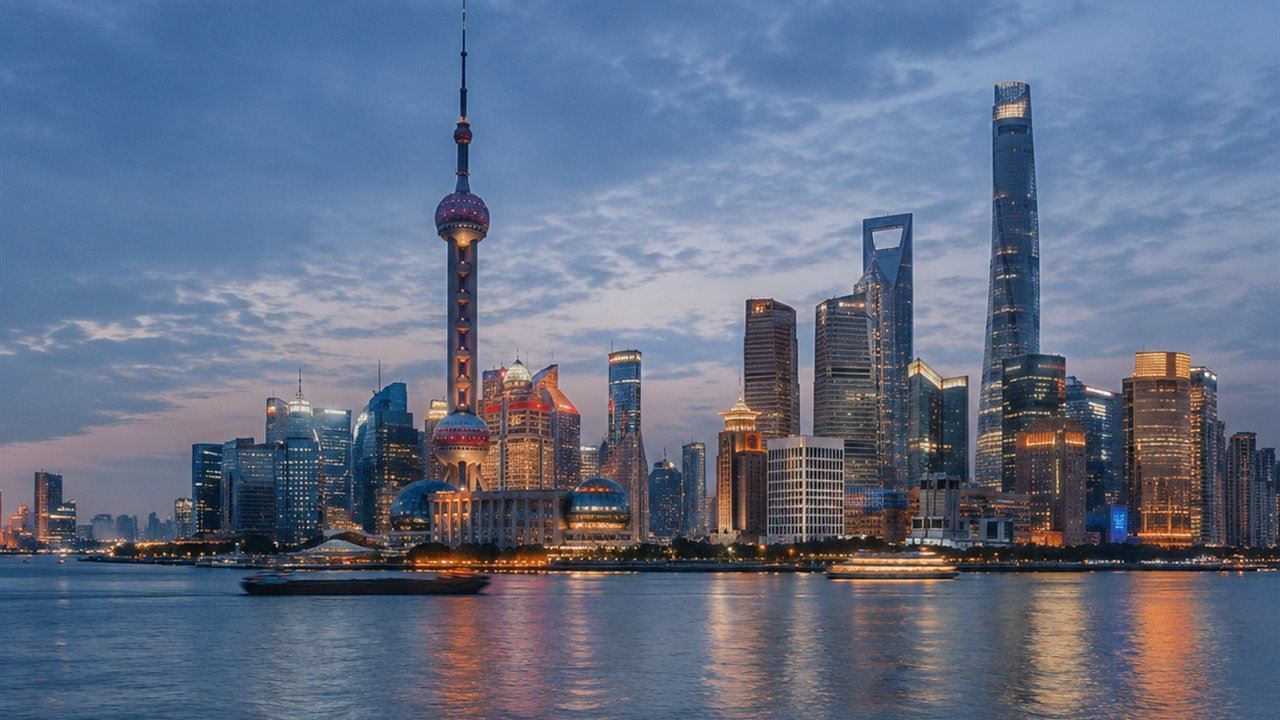
Shanghai is worth two to three days on a first trip to China, and it is the easiest big city in the country to arrive in: one airport with a fast rail link, a metro that takes foreign cards, and a compact historic core on the west bank of the Huangpu. Skip it if you want imperial monuments and temples, because Shanghai is a trading city, not a dynastic one.
- 2–3 days the useful range for a first visit
- CNY 50 / CNY 80 maglev one way / return to Longyang Road (2026)
- 8 minutes maglev journey, then metro line 2 or a taxi
- 40–60 minutes metro line 2 from Pudong Airport into the city
- Mar–May, Sep–Nov the two best windows (editorial judgement)
- Puxi for the historic core; Pudong for the skyline and the airport side
Last verified: 29 October 2026 · Sources: Shanghai municipal government, China Railway 12306, China Daily government channel, National Immigration Administration
Is Shanghai worth visiting?
Shanghai is worth visiting if you want a modern, walkable city where the trip runs on the metro and your feet, and where the sightseeing is a riverfront, a garden and a set of neighbourhoods rather than a palace. It is the least demanding city on the classic first-trip route, and the best place to end a China trip when you are tired of booking tickets.
| Book Shanghai if you… | Skip Shanghai if you… |
|---|---|
| Want a city you can walk and metro without fixed bookings | Want imperial palaces, temples and ancient walls |
| Care about modern architecture, food and nightlife | Are seeking landscape, mountains or countryside |
| Need an easy arrival — one main airport with a fast rail link | Have only three days in China and want Beijing only |
| Want a base for Suzhou and Hangzhou day trips | Expect cheap — Shanghai is the most expensive city on this site |
| Are flying out from Pudong at the end of the trip | Dislike big, dense, fast cities |
The trade is depth for ease. Shanghai does not have a single sight that justifies the trip the way the Forbidden City or the Great Wall does; what it has is a riverfront at two very different hours, a set of walkable neighbourhoods and the best food city in the country. Read the things-to-do ranking before you fix dates, because two entries change with the hour of the day.
Puxi or Pudong: which side of the river should you stay on?
Stay on the Puxi side for a first visit, because the Bund, the French Concession, Jing’an and Yu Garden are all there and the walking is better. Pudong is the skyline you cross the river to see, plus the airport side and the big hotels; it is convenient for an early flight and empty of atmosphere in the evenings away from Lujiazui.
| Choose Puxi if you… | Choose Pudong if you… |
|---|---|
| Want to walk to dinner and to the Bund at dawn | Have an early flight from Pudong and want a short transfer |
| Prefer neighbourhood streets, cafés and small hotels | Want the skyline view from your room |
| Are here for two nights and want everything close | Are on a business trip near Lujiazui or the exhibition centre |
| Want the historic city, not the view of it | Value a big-brand hotel over a small one |
The exception is the last night before an early departure: a hotel in Pudong near the maglev or line 2 removes the morning panic, and the view of the Puxi skyline from the east bank at night is the better photograph anyway. Decide after you have fixed your flight, not before.
When is the best time to visit Shanghai?
March to May and September to November are the best months to visit Shanghai, and they are the windows this guide assumes. Spring is the cleaner of the two, autumn is warmer and busier, and both avoid the two things that ruin a Shanghai visit: the plum rain of mid-June to early July and the typhoon season in August and September.
| Period | What it does to a trip | Our verdict (editorial unless sourced) |
|---|---|---|
| March–May | Mild, green, some rain | Best window — the city at its most walkable |
| September–November | Warm, clear, busy around 1–7 October | Best window — avoid the National Day week |
| Mid-June–early July | Plum rain: humid, damp, grey (sourced) | Avoid if your dates are flexible |
| August–September | Typhoon season (sourced) | Workable, but keep a wet-day plan |
| July–August | Hot and humid, domestic summer holiday | Busy and uncomfortable; early starts help |
| December–February | Damp cold, few crowds | Cheapest beds; pack for wind off the river |
| 15–23 February 2026 | Chinese New Year | The busiest week of the year — avoid |
If you are choosing between spring and autumn, take spring for the gardens and autumn for the light. The one date to avoid in either window is 1–7 October 2026, when domestic travel peaks and the Bund becomes a slow-moving crowd. The month-by-month guide puts Shanghai next to Beijing and Xi’an so you can sequence a route.
How many days do you need in Shanghai?
You need two full days in Shanghai as a minimum, and three if you want a day trip to Suzhou or Hangzhou without cutting the city. One day covers the Bund, Yu Garden and the French Concession; two adds the museums or Pudong; three makes a day trip possible and leaves the evenings free. Four is the first length that feels unhurried.
| Days | What you actually see |
|---|---|
| 1 day | The Bund at dawn, Yu Garden, a French Concession walk — no museum, no day trip |
| 2 days | Add the Shanghai Museum or Pudong and Lujiazui; the minimum that works |
| 3 days | Add Suzhou, Hangzhou or a water town as a day trip; the best-value length |
| 4 days | Add M50 or the Power Station of Art and a second neighbourhood; nothing feels rushed |
A three-day skeleton that uses the city well: day one, the Bund at 06:00 before the crowds, then Yu Garden and the old town, then the French Concession in the afternoon and a Huangpu night view. Day two, the Shanghai Museum in the morning and Pudong in the afternoon, crossing the river by metro or the sightseeing tunnel. Day three, a day trip to Suzhou or Hangzhou, returning for dinner. The ranked list fills the gaps around those anchors.
Where should you stay in Shanghai?
Stay near the Bund or in Jing’an for a first visit: the Bund puts the river and the old city within walking distance, and Jing’an puts you on the metro with restaurants on every corner. The French Concession suits anyone who wants trees, cafés and low-rise streets, and Pudong suits an early flight or a business trip. Wherever you choose, stay within a few minutes of a metro station.
| Area | Best for | Trade-off |
|---|---|---|
| The Bund / Huangpu | First-timers; the river at dawn and at night | Tourist-heavy and the most expensive rooms |
| French Concession / Xuhui | Trees, cafés, small hotels, walkable evenings | Quieter at night; a metro ride to the Bund |
| Jing’an | Central, connected, good food at every price | Busy roads; less picturesque than Xuhui |
| Pudong / Lujiazui | Skyline views and the airport side | Empty office-district evenings; fewer small restaurants |
Hotels register foreign guests automatically, so there is nothing to do on arrival; only a private stay needs registration within 24 hours. Two booking notes for Shanghai: room rates spike around the 1–7 October holiday and during the city’s big trade fairs, and a “Bund view” room usually means a partial view between buildings, so check the photograph rather than the label.
How do you get from Pudong Airport into Shanghai?
Pudong Airport (PVG) sits east of the city and connects by maglev, metro or taxi. The maglev costs CNY 50 one way or CNY 80 return and takes about 8 minutes to Longyang Road, where you change to metro line 2; the same line 2 runs the full journey from the airport in 40–60 minutes for a metro fare. Metro gates in Shanghai accept contactless foreign bank cards.
| Option | Fare (2026) | Time and where it drops you |
|---|---|---|
| Maglev + metro line 2 | CNY 50 one way, CNY 80 return | About 8 minutes to Longyang Road, then line 2 into the centre |
| Metro line 2 all the way | Metro fare, paid at the gate by card or app | 40–60 minutes to the central stations |
| Taxi or DiDi | Metered; check the fare in the app before you book | Door to door, but traffic decides the time |
The maglev is a novelty and a genuine time saver, but only as far as Longyang Road — you still need the metro or a taxi from there. If your hotel is in Jing’an or Xuhui, the all-metro option is often simpler with luggage: one seat, no transfer, no queue for a taxi. If you land late, book a DiDi inside Alipay rather than negotiating at the kerb.
Shanghai has a second airport, Hongqiao (SHA), which is closer to the city and shares a transport hub with Hongqiao railway station — useful if you are arriving by domestic flight or leaving by high-speed train. Check which airport your ticket names before you plan the transfer, because the two are on opposite sides of the city.
Which places define a first visit to Shanghai?
Six places carry a first visit: the Bund, Yu Garden and the old town, the French Concession, the Shanghai Museum, Pudong and Lujiazui, and one art district on the west bank. Everything else is a second trip. The table gives the reason to go and a realistic time, and the detailed version with costs and hours is on the things-to-do page.
| Place | Why it earns the time | Time needed (editorial) | Booking |
|---|---|---|---|
| The Bund | The riverfront and the 1920s banks; the reason people come | 1–2 hours, twice if you can | None |
| Yu Garden and the old town | A Ming garden and the crowded lanes around it | 1.5–2 hours | Check the official site for garden tickets |
| French Concession | Plane trees, villas, cafés — the city at street level | Half a day on foot | None |
| Shanghai Museum | Bronzes, ceramics and calligraphy in the national collection | 2–3 hours | Free at the time of writing; reservation required |
| Pudong / Lujiazui | The skyline you have seen in photographs, from underneath | 2 hours | Check each tower’s official page |
| The Bund at night | The same view, transformed; the better of the two visits | 1 hour | None |
The one thing to understand about Shanghai geography is that the river is the map: everything historic is west of it, everything glass is east. Cross once by metro during the day and once on foot at night, and the city makes sense. The attractions section covers the sights that need their own page.
Which day trips are worth it from Shanghai?
Suzhou and Hangzhou are the two day trips worth planning, and a water town is the third option if you want something smaller. Shanghai to Hangzhou is about an hour by high-speed train, which makes it a genuine day trip rather than an overnight; Suzhou is closer still. Book on 12306 with your passport, and check current times before you fix a plan.
| Day trip | Why go | Time and the practical catch |
|---|---|---|
| Hangzhou | West Lake, tea hills and a slower pace | About 1 hour by high-speed train; book on 12306 and check times |
| Suzhou | Classical gardens and canals; the closest city break | Check 12306 for current journey times |
| Zhujiajiao | A canal town within the Shanghai municipality | Reached by metro and bus; check the water-town ticket on its official page |
Do not attempt two day trips in three days. Each one costs a morning and an evening of transfers, and Shanghai’s own neighbourhoods are the thing most first-timers under-spend time on. If you have four days, take Hangzhou; if you have three, take Suzhou and keep the rest of the trip in the city.
What does a Shanghai trip cost?
Shanghai’s fixed costs are the transfer and the museums: CNY 50 one way or CNY 80 return for the maglev, a metro fare for line 2, and free entry at the Shanghai Museum with a reservation. Daily costs for a bed, food and local transport are editorial bands on our budget page, not official statistics, so use them for planning rather than as quotes — Shanghai sits at the top of the range for Chinese cities.
Payments work the same way as the rest of China, with one detail that catches people: a foreign card linked to Alipay or WeChat Pay can carry a 3% fee on the full amount when a transaction is above CNY 200, and nothing at or below that threshold. Split large purchases where you can, and use an ATM for cash — a single withdrawal is typically capped at CNY 3,000 with a bank fee of roughly CNY 20–30. The budget guide has the daily bands by travel style.
Shanghai’s municipal government English portal explains that foreign cards can be linked to Alipay and WeChat Pay without a Chinese bank account, subject to per-transaction and annual limits and a fee on larger transactions — see the Shanghai government payments guide, 21 September 2026.
What do first-timers get wrong in Shanghai?
First-timers lose Shanghai time in five predictable ways: seeing the Bund only at night, staying in Pudong for the atmosphere, treating Suzhou as a half-day, arriving at the wrong airport, and underestimating how far apart the neighbourhoods are. Each is a small planning decision, and together they are worth most of a day.
- Seeing the Bund once, at night. The riverfront at 06:00 is empty and the light is better; the 20:00 version is a crowd. Do both if you can.
- Booking Pudong for the view. The skyline is best seen from Puxi, and Pudong’s streets empty out after office hours.
- Squeezing in a day trip on a two-day visit. Shanghai’s neighbourhoods need the time more than Suzhou does.
- Confusing PVG and SHA. Pudong and Hongqiao are on opposite sides of the city; check the airport code on your ticket.
- Walking between districts. The French Concession to Lujiazui is a metro ride, not a stroll; plan hops rather than a loop.
FAQ
Is two days enough for Shanghai?
Two full days covers the Bund, Yu Garden, the French Concession and one museum or Pudong, which is enough to feel the city. It leaves no room for a day trip, so if Suzhou or Hangzhou matters to you, add a third day rather than cutting the city short.
Should you take the maglev from Pudong Airport?
Take it if you want the 8-minute ride and are heading somewhere on metro line 2, since it only goes as far as Longyang Road for CNY 50 one way or CNY 80 return and you still need the metro from there. With heavy luggage and a hotel in Jing’an or Xuhui, line 2 all the way is often simpler.
Can you visit Suzhou or Hangzhou without a tour?
Yes. Both are reached by high-speed train from Shanghai in about an hour or less, bookable on 12306 with your passport, and both stations connect to their city centres by metro or taxi. The only thing a tour buys is a guide; the transport itself is straightforward.
Do you need cash in Shanghai?
Very little. Alipay and WeChat Pay linked to a foreign card cover almost everything, and metro gates accept contactless foreign bank cards. Keep a few hundred yuan for small vendors, and note that a foreign card payment above CNY 200 through those apps can carry a 3% fee on the full amount.
Sources
- Shanghai municipal government — payments guide for foreign visitors (21 September 2026)
- China Railway 12306 — high-speed trains to Hangzhou and Suzhou, booked with a passport
- China Daily government channel — contactless foreign bank cards at metro gates (13 August 2025)
- Gov.cn — accommodation registration rules for foreign visitors (20 March 2026)
- Seasonal judgements, time allowances and cost bands — The China Door editorial, not official guidance
Next step: plan the two days that matter. The 15 things to do in Shanghai ranks the Bund by hour and adds the costs, and the Beijing guide covers the other half of the standard first-trip pairing.