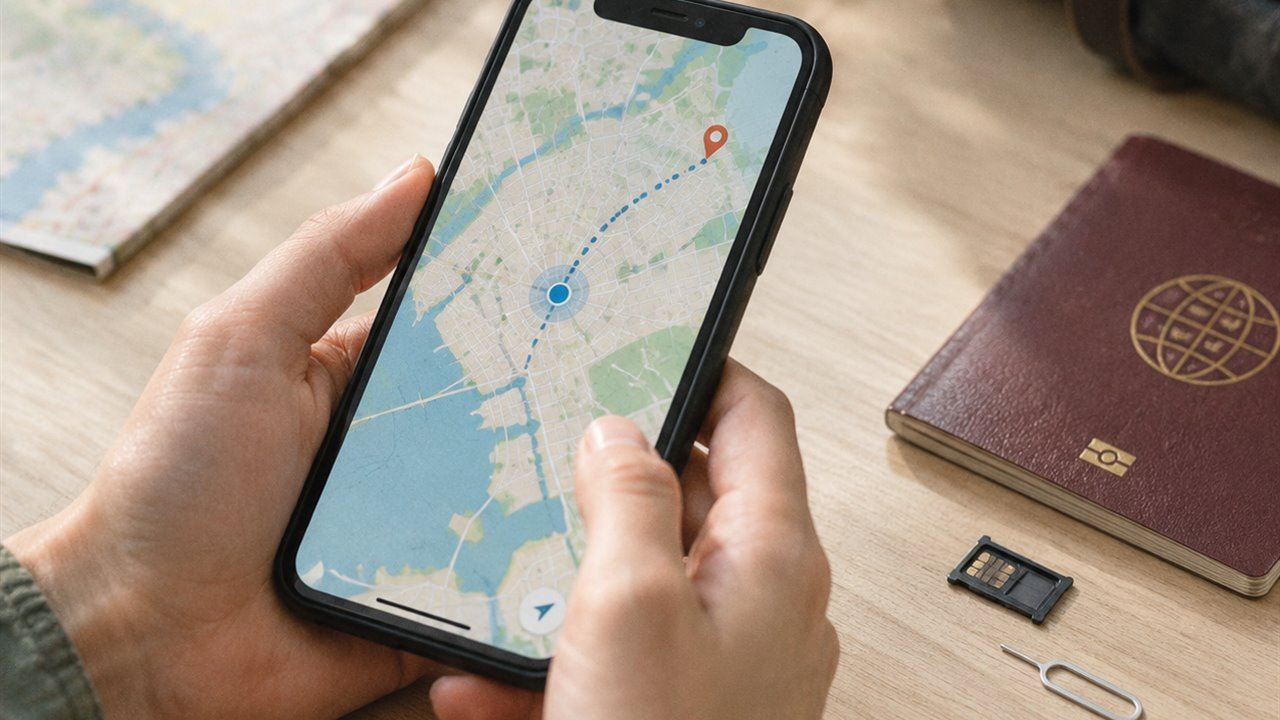
An international eSIM is the most dependable way to have data in China. Mainland carriers support local eSIM only on a limited set of handset models, and public Wi-Fi usually asks for a Chinese mobile number before it will send a login code. Buy and activate an international eSIM before you fly, keep your home SIM alive for verification texts, and treat the airport SIM counter as a backup.
- Limited models — mainland China supports local eSIM on some handsets only; most phones need an international eSIM (Travel China, 17 March 2026).
- Data-only — most travel plans cannot receive SMS, so finish account verification before you leave home.
- At home — buy, install and test the plan on your own network; it activates on landing.
- Passport needed — a physical local SIM is sold in person with real-name registration.
- Wi-Fi code — many public networks send the login code to a Chinese mobile number.
Last verified: 29 October 2026 · Sources: Travel China (Ministry of Culture and Tourism), Shanghai municipal government English portal, Chinese embassy notices
Does an eSIM work in China?
Yes, if it is an international eSIM bought outside mainland China. These plans connect through a foreign operator’s roaming agreement, so your traffic reaches a Chinese network without a Chinese identity document. What does not work reliably is buying a local Chinese eSIM after you land: mainland carriers currently support eSIM on a limited set of handset models, so most phones cannot load a local Chinese eSIM at all.
That single restriction changes the decision. If your phone is one of the supported models, a local eSIM bought in a carrier store with your passport is the cheapest per gigabyte. If it is not, and most phones are not, an international eSIM stops being a convenience and becomes the only option that does not involve a shop visit on arrival day.
Why can’t you just buy a SIM at the airport?
Because the airport is the worst place to discover a compatibility problem. Counters at Beijing Capital, Shanghai Pudong and Guangzhou Baiyun do sell tourist plans and they are a genuine backup, but each sale needs your passport original and real-name registration, and you join the queue with everyone else off your flight. Meanwhile the airport Wi-Fi wants a Chinese number for its code.
- The queue is the small problem. Real-name registration means the sale happens in person, with your passport, and cannot be arranged in advance or by someone else.
- The handset is the bigger problem. A local Chinese eSIM loads only on supported models, and counter staff cannot change that.
- The Wi-Fi catch is invisible until it matters. Many public networks in China, including some airport and hotel systems, authenticate by sending a code to a Chinese mobile number, and the internet and apps guide explains what that blocks.
Travel China, the English-language site run by the Ministry of Culture and Tourism, advises visitors that a local SIM is bought in person with the original passport under real-name registration, that mainland eSIM service currently covers only some handset models, and that most public Wi-Fi networks in China will not let you on without a Chinese mobile number. It recommends arranging connectivity before arrival rather than at the airport. Close paraphrase of Travel China’s connectivity guidance, 17 March 2026.
International eSIM, physical SIM or roaming: the three options compared
There are three ways to have data in China, and they differ on one question you will care about more than speed: can this line receive the text message that an app or a Wi-Fi portal sends? Only two of them can. The table compares the options on setup, SMS capability and the failure each one produces when it goes wrong.
| Option | How it works | Receives SMS codes? | Setup | What to watch |
|---|---|---|---|---|
| International eSIM | A data plan from a provider outside China, installed on your own handset and roaming on a Chinese network | Usually no: most travel plans are data-only | About 15 minutes at home; activates on landing | Data-only plans, hotspot rules that vary by provider, and profiles that cannot be reissued for free |
| Local physical SIM | A prepaid plan bought from China Mobile, China Unicom or China Telecom with your passport | Yes, once the SIM is registered | 20 to 60 minutes in person, plus the queue | Store hours, real-name registration, and losing your home number unless the phone takes two SIMs |
| Home-carrier roaming | Your existing plan used abroad, billed by your own operator | Yes, because your number does not change | Nothing to install; switch data roaming on | Daily charges, speed caps after a daily allowance, and plans that exclude China |
The pattern is simple. Roaming is the easiest and usually the most expensive per day. A local physical SIM is the cheapest per gigabyte and the most hassle. An international eSIM sits between them and wins on the point that matters for a short trip: it is the only option you can fully test before you leave.
What should you check before you buy?
Six things decide whether a plan works for you, and four of them sit below the price on the product page. Read the plan detail rather than the headline. If a provider will not state one of these plainly, that silence is your answer.
- Data-only or voice. Data-only is cheaper and enough for maps and QR payments, but it cannot receive SMS or make a normal call, and both limits matter for card verification in the payments guide.
- Hotspot and tethering. Some plans block it, which matters if you travel with a laptop or a second phone.
- Which Chinese network it roams on. Coverage in cities is rarely the issue; coverage in the countryside around Guilin or on a bus to Zhangjiajie is.
- When the clock starts. Some plans start at purchase and some at first connection. A plan that starts at purchase can burn days before you land.
- Whether it can be reissued. Deleting an eSIM profile by accident is common, and most providers charge to send a replacement.
- Fair-use limits. A plan advertised as unlimited often throttles after a daily allowance.
How to set it up at home, in five steps
Do this a week before you fly, on your home Wi-Fi, with the provider’s instructions open in a second window. The whole job takes about fifteen minutes, and it removes the one task nobody wants to be doing in an arrivals hall after a twelve-hour flight with luggage in both hands.
- Check the phone is carrier-unlocked and supports eSIM. On iPhone the setting is under Settings, General, About; on Android it is usually under Network or SIM settings.
- Buy a plan that explicitly covers mainland China for the exact dates of your trip, with a day or two of buffer rather than a week of unused days. Fix those dates against your entry route first: the China visa hub explains which rule you are travelling under and how long it lets you stay.
- Install the profile while on home Wi-Fi. Give it a name you will recognise, such as China data, so you never confuse it with your normal line.
- Leave the line switched off until you land. Do not delete the profile: an eSIM is a one-time install, and a deleted profile usually means buying another.
- Screenshot the QR code, the activation instructions and the support contact, because you may not be able to open the provider’s site if the plan fails on arrival.
On landing, turn the China line on, set it as the mobile data line, enable data roaming for that line only, and wait one to three minutes. If nothing happens, restart the phone before you change anything else; a restart fixes most first-connection failures.
What data actually costs
Pricing is the one part of this decision no article can settle for you, because plans are priced per provider and per market and change often. What can be compared is the shape of the bill: a short data-heavy week, a two-week trip and a month with hotspot use sit in three different bands, while roaming is usually priced per day rather than per gigabyte. Put the number against the rest of your daily spend, using the China travel budget as the baseline rather than judging the plan in isolation.
| Plan shape | Typical band | What drives the price |
|---|---|---|
| 3 to 5 GB, 7 days, data-only eSIM | about USD 5 to 15 | The provider’s wholesale rate and the market you buy in |
| 10 to 20 GB, 15 days, data-only eSIM | about USD 15 to 30 | Whether the plan includes hotspot use |
| 30 days, 20 GB or more, hotspot allowed | about USD 25 to 45 | Fair-use limits and whether speed is capped |
| Home-carrier roaming pass | usually charged per day | Your operator’s daily or monthly add-on for China |
| Local prepaid SIM from a Chinese carrier | lowest cost per gigabyte | In-person registration and the plan the counter offers that day |
Compare at least two providers at checkout and read what each says about hotspot use and reissue fees. International eSIM providers such as Airalo, Nomad or Holafly all sell China plans, and the differences that matter are in the small print rather than in the headline price.
What if the eSIM does not activate in China?
Most activation failures are one of five things, and four of them are fixed from the phone’s settings in under five minutes. Work through them in order before you buy a second plan, and do not delete the profile at any point, because that step cannot be undone cheaply.
- No data after landing. Set the China line as the mobile data line, switch on data roaming for that line only, then restart the phone.
- The line shows no service. The plan may roam on a single Chinese network. Open network selection, turn off automatic choice, and pick a network manually.
- It works, then slows to nothing. That is fair-use throttling after a daily allowance. Check the plan terms for the reset time.
- You need a verification code. A data-only line cannot receive it. Use Wi-Fi calling on your home line if your carrier offers it, or rely on the accounts you verified before departure.
- You want a refund. Most providers refund only if the eSIM was never activated, so raise the request before you scan the code on arrival.
Some links on this page are affiliate links. If you buy through them we may earn a commission at no extra cost to you. We do not accept payment for rankings.
FAQ
Can I buy a Chinese eSIM after I land?
Only if your phone is one of the models mainland carriers support for eSIM, which is a short list. Every other phone needs either an international eSIM bought before departure or a physical prepaid SIM from a carrier store, bought in person with your passport.
Will an international eSIM give me a Chinese phone number?
No. Travel eSIMs are data plans; they do not issue a Chinese number, so they cannot receive the SMS codes that some public Wi-Fi portals and some app sign-ins require. Keep your home SIM active for texts, or verify those accounts before you fly.
Can I make calls with a data-only eSIM?
Not ordinary calls, and no texts to a normal phone number. Voice over data works if you use an app that supports it and the connection is good. If you need a working local number for deliveries or reservations, buy a physical local SIM instead.
Does the eSIM work for Alipay and WeChat Pay verification?
Sometimes, but do not rely on it. Both apps can send a verification code by SMS, and a data-only plan will not receive one. Link your card and complete verification while you are still at home on your home number, then travel with the account already working.
Sources
- Travel China (Ministry of Culture and Tourism) — SIM cards, eSIM and public Wi-Fi (17 March 2026)
- Chinese embassy — online arrival card e-filing, in force since 20 November 2025 (notice published January 2026)
- National Immigration Administration — accommodation registration notice (20 March 2026)
- Hunan provincial government — booking transport with a foreign passport (29 May 2025)
Data is one of four systems you have to set up before you land. Read the practical China hub to see the order that works, and start with money next.
Disclosure: this page may contain affiliate links. If you book through them, we may earn a commission at no extra cost to you, and it never changes what we recommend. See our affiliate disclosure.