

Pick Mutianyu for a first visit: it has restored walkway, a cable car up and a toboggan down, and far fewer people than Badaling. Choose Badaling if you are relying on public transport and want the simplest possible day. Choose Jinshanling if you want empty ridges and are willing to pay for a two-hour drive. All three headline sections use real-name ticketing, so book before you go.
- Which section: Mutianyu by default, Badaling for transport simplicity, Jinshanling for hiking and quiet.
- Best months: April, May, September and October. Go at opening whatever the month.
- Ticket: priced in CNY, set each year, real-name with passport. Confirm the current 2026 price and the daily cap on the official channel.
- Opening pattern: daily from early morning, with seasonal hours; the earliest hour is the only quiet one.
- Time needed: a full day from central Beijing, 6 to 8 hours door to door.
- Booking: required for Badaling at peak and recommended everywhere; Badaling publishes a peak cap of about 65,000 visitors a day.
- Walk: 2 to 4 km of wall is realistic for most visitors; the terrain is steep and stepped, not a gentle path.
Last verified: 29 October 2026 · Sources: Badaling official booking channel, Beijing municipal transport information, UNESCO World Heritage List
Which Great Wall section should you choose?
Choose the section by how you are getting there and how many people you can tolerate. Mutianyu is the best all-round answer for a first trip. Badaling is the easiest by public transport and the most crowded. Jinshanling is the best walking and the emptiest, at the cost of a long drive and a full day. None of them is the “real” wall in a way the others are not.
| Section | Drive from Beijing | Crowds | Cable car | Hike difficulty | Best for |
|---|---|---|---|---|---|
| Mutianyu | About 1h30 | Moderate, manageable by 09:00 | Yes, plus a toboggan down | Steep in places, restored steps | First visits, families, mixed fitness |
| Badaling | About 1h to 1h30 by road; rail link available | Heaviest, capped at about 65,000 a day at peak | Yes | Very steep in sections, wide restored walkway | Public transport, short trips, mobility limits |
| Jinshanling | About 2h30 to 3h | Light except at sunrise | No | Long ridge walk, partly unrestored, hard | Hikers, photographers, second visits |
| Huanghuacheng | About 2h | Light | No | Steep and uneven, partly unrestored | Photography, quieter days, older children |
| Simatai / Gubeikou | About 2h30 to 3h | Light to moderate | Simatai yes, Gubeikou no | Very steep at Simatai; Gubeikou unrestored | Hikers and second visits |
Two things the table cannot show. Badaling’s visitor cap does not make it quiet; it makes it predictable, which is different. And the unrestored sections, Jinshanling and Gubeikou in particular, are uneven underfoot, with loose brick and no handrails, so they are the wrong choice for anyone unsure on their feet. Simatai runs a night tour on part of its stretch, which is genuinely different from a daytime visit but not a substitute for walking the wall in good light.
Mutianyu or Badaling: which is better for a first visit?
Mutianyu, for almost everyone. The wall there is restored to a similar standard, the ridge line is more dramatic, and the visitor numbers are a fraction of Badaling’s even at midday. The trade-off is that you need a car, a tour or a long bus ride rather than a train, and the ticket does not include the cable car.
Badaling wins on one thing that matters: logistics. It has a dedicated rail link from Beijing and frequent buses, so a solo traveller without a car can do the whole day without hiring anything. If your trip is short, your budget is tight, or you are nervous about arranging a driver, that convenience is worth the crowds. If you have a group and a driver, Mutianyu is the better day for the same money.
Both are restored, both have cable cars, and both are steep. The difference is atmosphere: Badaling is a monument with a car park, Mutianyu is a ridge with a village at the bottom. Families usually prefer Mutianyu because the toboggan down is the thing children remember, and because the walk between towers is shorter and shadier.
Is Jinshanling worth the extra drive?
Yes, if you are fit, you have a full day, and you want the wall without a crowd in the photograph. Jinshanling is partly unrestored, sits on a long ridge of watchtowers, and is the section hikers ask for by name. The cost is roughly two and a half to three hours each way by road, which rules it out for a short trip.
Go with a driver who will wait, not a one-way transfer: the return is the hard part, and phone signal on the ridge is patchy. Start early enough to walk a few towers before the sun is high, and take more water than you think you need, because there is very little on the wall itself. The village at the base has simple restaurants, and cash is useful.
Jinshanling is also the section most often sold as a “wild wall” hike with a guide who walks you from a neighbouring village. Those hikes are legitimate but vary in quality; if you book one, confirm whether the price includes the entrance ticket and the return transport, because the two are often quoted separately.
How do you get to the Great Wall from Beijing?
By road for Mutianyu, Jinshanling, Huanghuacheng and Simatai, and by rail or road for Badaling. A private car or a small tour is the simplest for Mutianyu, roughly 1h30 each way from central Beijing. Badaling has the S2 suburban train from Beijing North and the 877 tourist bus, which makes it the only section you can reach comfortably without arranging a vehicle. Both are cheap, and both are worth confirming the day before you go, because timetables shift with the season.
| Section | Best transport | Time each way | Notes |
|---|---|---|---|
| Mutianyu | Private car, taxi or small tour | About 1h30 | Arrange the return; taxis are scarce at the base |
| Badaling | S2 suburban train from Beijing North, or bus 877 | About 1h to 1h30 | Book the rail seat with your passport; the 877 is the tourist bus |
| Jinshanling | Private car with driver waiting | About 2h30 to 3h | Agree the waiting time and return fare up front |
Fares and timetables change with the season, so confirm the current arrangement the day before rather than trusting a guidebook. For rail, the passport you booked with is the ticket, and you should arrive 45 to 60 minutes before departure at a big Beijing station. Our high-speed train guide covers the procedure, and the Beijing destination guide puts the wall into a two-day city plan.
How long does the Great Wall take?
A full day, and plan for six to eight hours door to door. That is 1.5 to 3 hours of driving each way depending on section, an hour at the ticket gate and cable car, three to four hours on the wall, and a meal at the base. Anyone who tells you it is a half-day from central Beijing is counting only the wall.
On the wall itself, most visitors manage 2 to 4 km between towers, which is two to three hours at a realistic pace including stops. The steps are uneven and some sections are steep enough to need a hand on the rail. Families with young children should halve that and add a cable car in both directions rather than walking the approach path.
Build in slack for the two things that always take longer than expected: the queue for the cable car at Mutianyu in peak season, and the walk back from the last tower to the exit. If you want to combine the wall with the Ming Tombs, do it from Badaling or Mutianyu, because the tombs sit on the road back to Beijing and the detour costs an hour rather than a redirection. You need to be off the wall by early afternoon for that to work, which means the earliest possible start.
What should you see in what order on the wall?
At Mutianyu, take the cable car up, walk the restored stretch toward the higher towers in the direction with the better ridge view, and come down by toboggan if the queue is short. At Badaling, go north from the main gate rather than south, because the north side has the longer run of towers. At Jinshanling, walk west from the main entrance for the quieter towers.
The order matters because the wall is one long staircase and you want to be walking toward the view, not away from it. At Mutianyu the cable car puts you near the middle of the restored section, so you can choose direction at the top; most people walk toward the towers that climb the ridge, which is also the steepest option. If your knees are a concern, walk the flatter stretch and skip the climb, then ride down.
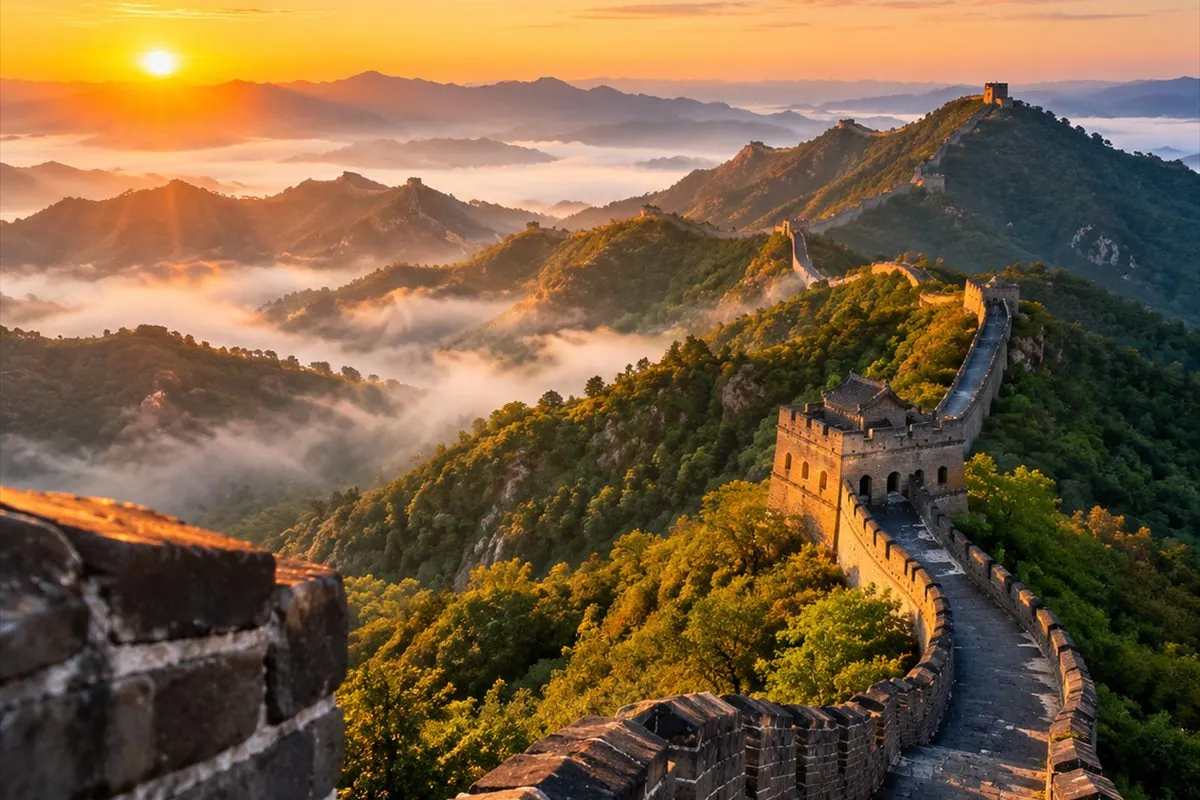
Photography: the wall faces east-west in most sections, so early morning and late afternoon give the long shadows that make the ridge legible. Midday light flattens it. If you are on the wall at 09:00 you have both the light and the emptiness, which is the whole reason to leave Beijing at 07:00.
What mistakes do visitors make at the Great Wall?
The two expensive ones are arriving without a ticket on a capped day, and hiring a driver who does not wait. The two common ones are starting too late and walking the wrong direction. None of them require anything more than booking the night before and leaving early.
- Arriving at Badaling at 10:30 on a holiday weekend, when the daily cap is already reached.
- Booking a one-way transfer to Mutianyu, then discovering there is no taxi back.
- Assuming the cable car is included in the entrance ticket; it is separate at Mutianyu.
- Wearing smooth-soled shoes on steps worn by six centuries of feet.
- Walking past the last tower into unrestored sections without a guide, at Jinshanling especially.
- Leaving the passport in the car, then queueing twice at the gate.
- Treating the wall as a photo stop and budgeting an hour for it.
- Booking a “Great Wall tour” from a station tout or a hotel lobby with no operator name; unlicensed tours are the commonest way visitors overpay.
- Queueing for the Mutianyu toboggan in rain or high wind; it closes in bad weather and the walk down is the fallback.
The wall is not one place. Picking the section is the decision; everything else about the day follows from it.
Is the Great Wall worth it for families and non-hikers?
Yes, if you pick the right section and use the cable car. Mutianyu with a cable car up and toboggan down is manageable for children over about six and for adults who do not want a hike, and the village at the base has food and toilets. Badaling is flatter at the gate and has the easiest public transport, but the crowds are harder on small children.
For anyone with limited mobility, the honest answer is that no section is fully accessible: the wall is a staircase by design. Badaling and Mutianyu both have cable cars that remove most of the climb, and both have restored walkways near the stations, but the towers themselves have steep, narrow stairs. Check with the section’s ticket office about the current lift or shuttle arrangements before you commit.
For travellers who have seen the wall before, Jinshanling or a sunrise hike on a less-visited section is a better second visit than a repeat of Badaling. For a first visit on a tight schedule, one full day at Mutianyu is enough, and it is better than trying to see two sections in one trip.
FAQ
Can you visit the Great Wall from Beijing in one day?
Yes, and one day is the normal unit. Mutianyu and Badaling work as day trips from central Beijing; Jinshanling needs an early start and a driver who waits. You will be back in the city for dinner, but not much earlier.
Which Great Wall section is least crowded?
Jinshanling, by a wide margin, because the drive deters casual visitors. Among the restored sections, Mutianyu before 09:00 is quieter than Badaling at any hour. Badaling’s daily cap of about 65,000 at peak tells you what to expect on a holiday.
Do you need to book Great Wall tickets in advance?
Book ahead for Badaling and for any holiday date, and book Mutianyu in peak season. Ticketing is real-name with your passport, and the official channel is the only place the current 2026 CNY price is authoritative. Our attractions hub covers which sites need booking first.
Is the Great Wall worth it in winter?
Yes, and it is underrated: fewer visitors, clear ridges, and the wall reads better against bare trees. The trade-offs are ice on the steps, an early sunset, and cable cars that can close in wind. Check the section’s operating status the day before.
Sources
- Badaling Great Wall official site and booking (checked 29 October 2026)
- UNESCO World Heritage – The Great Wall
- China Railway 12306 – English booking and timetables (checked 29 October 2026)
- State Council General Office – 2026 public holiday arrangements (11 December 2025)
Next step: decide between Mutianyu and Badaling, then check the date against the best-time-to-visit guide and slot the day into the 7-day itinerary.
Disclosure: this page may contain affiliate links. If you book through them, we may earn a commission at no extra cost to you, and it never changes what we recommend. See our affiliate disclosure.